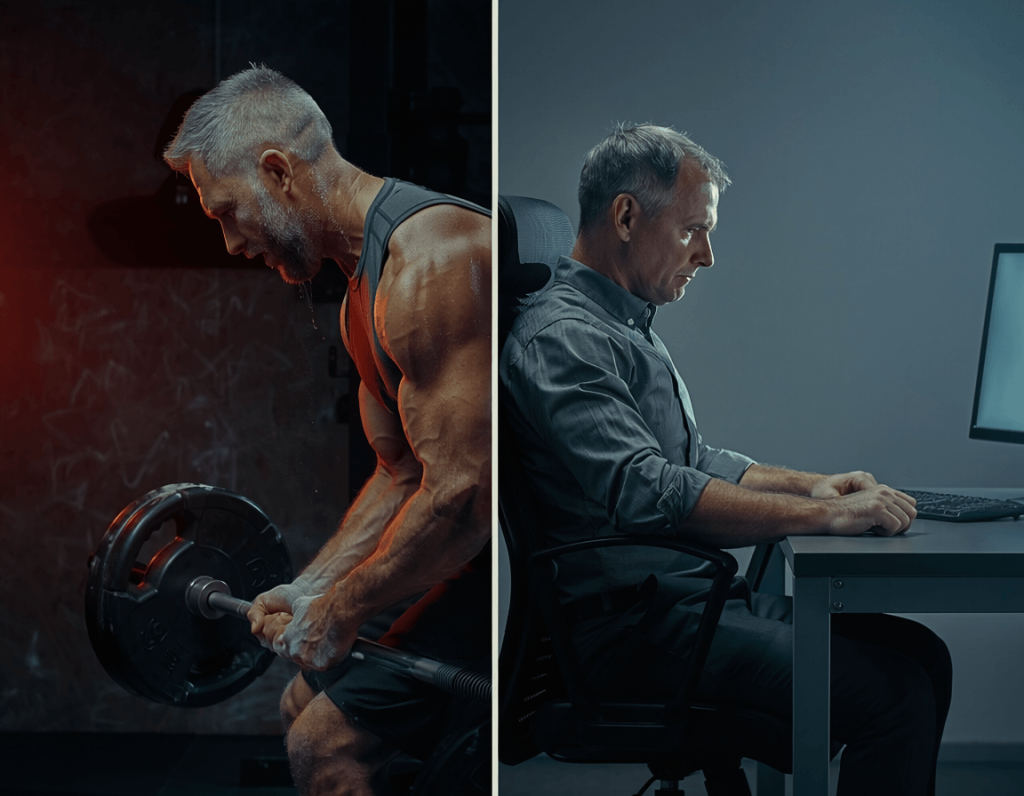
Muscle soreness after 40 comes in two flavors, and you don’t get to opt out of either one. You’re going to be sore. That part isn’t negotiable. Somewhere between 40 and dead, your body is going to ache, and no amount of clean eating or positive thinking is going to change that fact.
What you get to choose is which kind.
There’s the sore that comes from loading a barbell, from pushing a set past where it got comfortable, from making your muscles do something they weren’t sure they could do. And there’s the sore that comes from sitting in the same chair for nine hours, sleeping wrong, and standing up too fast because your hip forgot how to hip.
One of those builds you. The other one is quietly taking you apart.
I tell my clients this all the time. Choose your sore. You don’t get the option of “no soreness.” You get to pick which direction it’s pointing.
The Ache That Means You’re Growing
The soreness you feel a day or two after a hard workout has a name: Delayed Onset Muscle Soreness, or DOMS. It shows up when you load a muscle with something new or something harder than it’s used to, and the fibers develop microscopic tears. Not injuries. Not damage in the sense your brain wants to panic about. Controlled, small-scale disruption that your body immediately gets to work repairing.
That repair process is the whole point. Your body doesn’t just patch the tear and move on. It rebuilds the fiber a little thicker, a little stronger, a little more prepared for the next time you ask it to do that thing. This is literally the mechanism behind every gain you’ve ever made in the gym. The soreness isn’t a side effect of progress. It’s the receipt.
After 40, this matters more, not less. You’re fighting a background process called sarcopenia, the gradual loss of muscle mass and strength that starts creeping in around your thirties and picks up speed with every decade you don’t actively resist it. Left unchecked, sarcopenia doesn’t just make you weaker. It’s tied to falls, fractures, loss of independence, and yes, earlier death. Muscle isn’t vanity past a certain age. It’s insurance.
So when you’re sore from a hard leg day at 47, that ache is your body actively pushing back against the decline everyone else your age is just accepting. It’s uncomfortable. It’s also one of the healthiest things you can feel.
The Ache That Means You’re Rotting
Then there’s the other sore. The one that shows up with no workout attached to it at all.
Your lower back seizes up after a long drive. Your knees crack like a campfire when you get out of bed. Your shoulders ache from hunching over a laptop for a decade. None of that came from doing too much. It came from doing nothing, repeated daily, for years.
This is the soreness of disuse. When a joint doesn’t move through its full range regularly, the tissue around it stiffens. When a muscle doesn’t get asked to produce force, it starts shedding capacity it doesn’t think it needs anymore. Circulation slows. Connective tissue loses elasticity. Your nervous system gets worse at coordinating movement simply because it hasn’t had to in a while. None of this requires an injury or an event. It just requires time and inactivity, which most men over 40 have in abundance.
The cruel part is that this kind of ache feels like getting old. It doesn’t feel like a consequence of a choice, so most guys never question it. They just accept the stiff back and the cranky knees as the toll of turning 45, when in reality it’s the toll of turning 45 while doing almost nothing physically demanding.
That ache in your back isn’t proof you’re aging. It’s proof you’ve stopped asking your body to do anything, and your body, being efficient, took you up on the offer.
Same Discomfort, Opposite Destinations
Here’s the part most men miss: both kinds of sore feel bad in the moment. Sitting down after leg day hurts. Getting out of bed with a stiff back hurts. If you’re only paying attention to the sensation, they can seem like the same problem, and that’s exactly the trap. A guy who hates being sore will often avoid the gym to dodge DOMS, not realizing he’s guaranteeing himself the other kind of sore instead. There is no version of this where you opt out of discomfort. You only get to pick which discomfort is doing something for you.
DOMS resolves in a few days and leaves you stronger than before. The soreness of neglect doesn’t resolve. It compounds. It shows up more often, in more places, and takes longer to ease off each time, because the underlying problem, disuse, is still there and getting worse.
One is a receipt for progress. The other is a bill coming due.
Choose Yours
Most men never learn the difference between these two aches, because nobody ever laid it out for them. They just feel discomfort and try to avoid it, without asking what kind of discomfort it is or what it’s building toward.
You’re 40, 45, 50-something. You are going to be sore. That ship sailed the day you were born into a body that ages. The only decision left on the table is which sore you’re going to have.
Sore from lifting something heavy, or sore from lifting nothing at all. Sore from building the body that gets you to 80 still able to get off the floor by yourself, or sore from the slow erosion that gets you there needing help. Sore for a better quality of life, or sore for a worse one.
Choose your sore. Nobody else is going to choose it for you.